
Professional Driver’s License: Requirements & How to Convert from Non-Pro
If you want to drive for a living in the Philippines, a regular non-professional license is not enough. Taxi, delivery, ride-hailing, truck and bus work all call for a professional driver’s license (PDL) issued by the Land Transportation Office (LTO). The good news is that you do not start from zero: if you already hold a non-professional license (NPDL), you can upgrade it.
This guide explains who qualifies, what documents you need, which exams you take, how much you can expect to pay and the exact steps to follow. Rules and fees change, and different guides online do not always agree, so treat this article as a roadmap and confirm the latest details with your LTO office or your LTMS account before you go. For more licensing, registration, and vehicle-service guides, visit our main LTO Tracker.
What Is a Professional Driver's License?
Before you gather documents, it helps to know what a professional license is and how it differs from a non-professional one. This section covers the basics in plain language. Before starting the conversion, make sure you can access your account through the LTO Portal login and registration guide.
Professional vs Non-Professional License
A non-professional license allows you to drive your own or a family vehicle for personal use. A professional license allows you to drive for hire, meaning you are paid to drive as your job. Employers, ride-hailing platforms and public transport operators generally require the professional version.
Who Needs a Professional License?
You generally need a PDL if you plan to work as:
- A taxi, jeepney or bus driver
- A delivery or truck driver
- A ride-hailing or app-based driver
- A company driver or chauffeur
- A driver of any vehicle used for hire or commercial purposes
If your work involves being paid to drive, check with your employer or platform, then confirm with the LTO.
Why You Upgrade Instead of Applying Fresh
The LTO process is built around converting an existing non-professional license. In practice, this means you apply for a change in classification, from non-pro to pro, rather than getting a brand-new professional license from scratch.
Eligibility to Convert From Non-Pro to Pro
Not everyone can upgrade right away. This section explains the basic conditions the LTO looks at before it accepts your application. For a broader explanation of license types, validity, renewal, and requirements, read our LTO Driver’s License guide.
General Requirements
According to commonly cited LTO guidance, you must:
- Be at least 18 years old (some vehicle types may require an older age)
- Be physically and mentally fit to drive
- Be able to read and write in Filipino, English or a major dialect
- Have no unsettled traffic violations
- Hold a non-professional license
How Long You Must Hold Your Non-Pro License
Guides commonly mention minimum holding periods that depend on your restriction code:
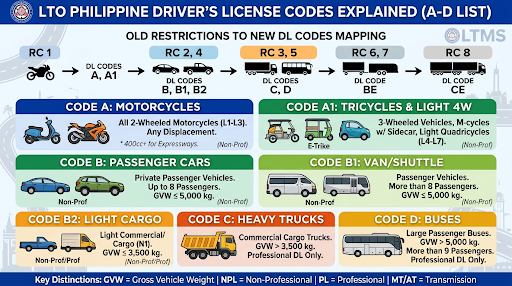
- Restriction code 1 (DL codes A and A1, motorcycles and tricycles): at least 6 months
- Restriction codes 2 and 4 (DL codes B, B1 and B2, cars, vans and similar): at least 1 year
Some guides apply these periods specifically to expired licenses, while others describe them as general rules. Ask your LTO office how it applies to your case.
Demerit Points and Waiting Periods
If you have demerit points from traffic violations, you may have to wait before changing your classification. Commonly reported waiting periods are 3 months for 1 to 2 points, 6 months for 3 to 4 points and 1 year for 5 or more points, counted from the date you settle your fines.
Special Cases
- Medical condition codes: applicants with certain condition codes may need clearance from an LTO-accredited specialist to drive for hire.
- Adding a restriction code: you may not be eligible if you have multiple reckless driving counts during your current license period.
- Foreign nationals: a valid working visa is required, along with other documents.
Professional Driver's License Requirements
Showing up with a complete set of documents is the best way to avoid delays. Here is the checklist most guides agree on, along with items that may vary by office. If you have forgotten your LTMS credentials, follow these steps to retrieve your LTO Portal account.
Core Documents
- Accomplished application form, available from the LTO office or the LTMS portal
- Original valid non-professional driver’s license
- Taxpayer Identification Number (TIN) issued by the BIR
- Medical certificate from an LTO-accredited clinic, transmitted electronically
- Negative drug test result from an LTO-accredited facility
- Clearance such as an NBI, police or court clearance, or a commanding officer’s certificate where applicable
About the Medical Certificate
The medical certificate must come from an LTO-accredited clinic, and the clinic sends it electronically to the system. Validity is described differently across sources, with many recent guides saying 15 days, so complete your transaction soon after your exam and verify the period with your clinic or the LTO.
About the Drug Test
A negative drug test from an LTO-accredited facility is commonly listed for professional applicants. Because some guides specify how recent the test must be, ask the facility how long the result remains acceptable for your application.
Extra Items to Prepare
- A valid government-issued ID and photocopies
- Passport-size photos if your office asks for them
- Cash for fees and payment receipts
- Any specialist clearance or additional paperwork required for your case
Some guides also mention theoretical and practical driving courses for professional applicants. Because this is not consistently listed in official-style requirement lists, confirm with your LTO office whether a course certificate applies to you.
Exams You May Need to Take
Which exams you take depends on the state of your current license and whether you are adding a new restriction code. This section explains the common scenarios.
Valid License, No New Restriction Code
If your non-pro license is still valid and you are only changing the classification, guides generally say you take the written exam only.
Adding a Restriction Code
If you also want to add a vehicle category, such as moving from motorcycles to cars, expect both the written and the practical exams for that code.
Expired or Dormant Licenses
If your non-pro license has expired or has been unused for a long time, you typically take both the written and the practical exams. If it has been expired for more than two years, the practical driving test may come first.
What Happens If You Fail
Failing the written exam usually means you can return on another day. Failing the practical test generally ends that transaction, and you must apply again. Study the handbook and practise driving before your exam date.
Tips to Pass
- Review road signs, right-of-way rules and traffic laws.
- Practise with online sample questions.
- Get enough sleep and arrive early.
- For the practical test, stay calm, check mirrors and follow signals carefully.
Professional Driver's License Fees
Costs vary by situation, so use the figures below as estimates and check your LTMS assessment for the exact amount. Once your licensing concerns are sorted, you can also learn how to check your LTO plate number for vehicle-record concerns.
Fees for a Valid Non-Pro License
Commonly reported fees for converting a valid license are:
- Application fee: PHP 100
- License replacement fee: PHP 225
- Change of classification fee: PHP 100
- Estimated total: PHP 425
Fees for an Expired License
For an expired license, guides often list an application fee, a renewal fee of around PHP 585 and the classification fee, plus penalties based on how long the license has been expired:
- Expired up to 1 year: PHP 75
- Expired over 1 year up to 2 years: PHP 150
- Expired over 2 years up to 10 years: PHP 225
The total is commonly reported at around PHP 785 plus penalties.
Other Costs to Budget For
- Additional restriction code: around PHP 100 or more, depending on the guide
- Medical examination: set by the clinic, with a PHP 300 cap announced in 2023 although some clinics still charge more
- Drug test: charged separately by the facility
- Clearance fees such as NBI or police clearance
- Travel and food on exam day
Step-by-Step: How to Convert Non-Pro to Pro
Follow this order to keep your visit smooth. If your office uses the LTMS for appointments, book a slot first.
Step 1: Prepare Your Documents
Get your medical certificate, drug test result, clearance, TIN and original non-pro license ready. Make photocopies of your ID and key documents.
Step 2: Check Your LTMS Account and Appointment
Log in to your LTMS portal account, check your license details and book an appointment if available. Not every office handles every transaction the same way, so confirm whether yours accepts walk-ins.
Step 3: Visit the LTO Office and Submit Requirements
Go to the LTO office, take a queue number, submit your application form and documents, and wait for the evaluator to check them.
Step 4: Take the Required Exams
If exams apply to your case, take the written exam first, then the practical exam if needed. Passing moves you to the next step.
Step 5: Pay the Fees
Proceed to the cashier and pay the assessed amount. Keep your official receipt.
Step 6: Biometrics and Encoding
Go to the encoding window to have your photo, signature and fingerprints captured. Check that your details are correct before leaving the window.
Step 7: Claim Your License
You will receive a claim stub or temporary document. Return on the date indicated to collect your professional license, signing the log sheet when you claim it.
Tips for a Faster, Smoother Application
A few simple habits can save you hours at the LTO office. Use these tips before you go.
Go Early on a Weekday
Offices are busiest on Mondays and at the end of the month. An early weekday visit usually means shorter lines.
Use Accredited Providers Only
Take your medical exam and drug test only at LTO-accredited facilities. Certificates from other places will not be accepted.
Avoid Fixers
Never pay anyone who promises to skip exams or speed up your license. It is illegal, it can invalidate your application, and you may lose money.
Check Details Twice
Make sure the name, birthdate and address on all your documents match exactly. Small differences cause big delays.
Common Mistakes to Avoid
These are the problems applicants run into most often.
Expired or Wrong Medical Certificate
Taking the medical exam too early or at a non-accredited clinic means you may have to repeat it. Time it close to your application and verify accreditation.
Missing Clearances or TIN
Forgetting a clearance or your TIN can stop your transaction at the counter. Keep a checklist and tick off each item.
Ignoring Unpaid Violations
Unsettled traffic violations can block your application. Settle fines before your visit.
Relying on Outdated Information
Rules, fees and systems change. Always verify with the LTO or your LTMS account before paying for anything.
Frequently Asked Questions
Can I get a professional license without a non-pro license?
The usual route is to upgrade an existing non-professional license, so you generally need to hold one first.
How long do I need to hold a non-pro license?
Commonly cited periods are 6 months for motorcycle-related codes and 1 year for car and van codes. Confirm how this applies to you at your LTO office.
How much does it cost to convert non-pro to pro?
For a valid license, many guides report about PHP 425 in LTO fees, plus separate costs such as the medical exam, drug test and clearance.
Do I need to take an exam?
Usually the written exam is required, and a practical exam is added if you are adding a restriction code or your license is expired.
Is a drug test required?
A negative drug test from an LTO-accredited facility is commonly listed for professional applicants.
Can I do everything online?
Some steps, such as appointments and verification, are handled through LTMS, but exams and biometrics usually require an office visit.
Conclusion
Upgrading from a non-professional to a professional driver’s license is straightforward when you prepare properly. Check that you meet the age and holding-period rules, gather your documents, choose accredited clinics, prepare for the exams and follow the LTO steps in order. Because fees and requirements can differ by case and over time, always confirm the latest details with the LTO or your LTMS account before you pay.

