
LTO Restriction Codes Explained: A, A1, B, B1, B2, C, D
If you’ve ever looked at your Philippine driver’s license and wondered what those letters next to your name actually mean, you’re not alone. Since the Land Transportation Office moved away from the old numbered restriction system, drivers are now issued DL Codes instead a set of letters like A, A1, B, B1, B2, C, and D that determine exactly which vehicles you’re legally allowed to operate.
Misunderstanding your restriction codes isn’t just confusing, it can also lead to fines or penalties if you end up driving something outside your licensed category. This guide breaks down every LTO restriction code in plain language, explains which vehicles fall under each one, and shows you how the old system maps to the new one. Track your plate, licence or registration status anytime with our LTO tracker
Why LTO Switched from Restriction Codes to DL Codes
Before the current system, the LTO used a set of numbered restriction codes (1 through 8) based mainly on a vehicle’s weight and clutch type. While functional, this older system left a lot of room for confusion, since it didn’t clearly separate vehicle categories by seating capacity, cargo weight, or vehicle class.
To fix this, the LTO introduced a more detailed DL Code framework that accounts for seating capacity, gross vehicle weight (GVW), and vehicle classification. This new system uses nine total DL Codes A, A1, B, B1, B2, C, D, BE, and CE with each one authorizing a specific, clearly defined category of vehicle.
How Old Restriction Codes Map to New DL Codes
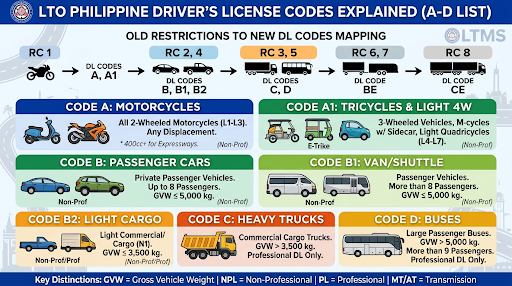
If you held an older license, your restriction codes were automatically converted during renewal. Restriction Code 1 became DL Codes A and A1. Restriction Codes 2 and 4 became B, B1, and B2. Restriction Codes 3 and 5 became C and D. Restriction Codes 6 and 7 became BE, and Restriction Code 8 became CE. This conversion happens automatically whenever a license is renewed or upgraded through the Enhancement of Driver’s License service.
DL Code A – Motorcycles
DL Code A is the most straightforward of the restriction codes. It covers all two-wheeled motorcycles without a sidecar, regardless of engine displacement. Your restriction codes appear in your account once you complete the LTO portal login and registration.
What You Can Drive Under Code A
This code applies to vehicles under categories L1, L2, and L3, meaning everything from small 50cc scooters to full-sized superbikes. Whether you’re riding a Honda Click, a Yamaha NMAX, or a high-displacement machine like a Kawasaki Ninja or Ducati Panigale, Code A is what authorizes it.
Expressway Rules for Code A Holders
One important detail for motorcycle riders: sub-400cc motorcycles are not allowed on major expressways such as NLEX, SLEX, Skyway, and TPLEX, regardless of your license code. Only riders with motorcycles of 400cc or higher, paired with a valid Code A license, are permitted on these expressways.
DL Code A1 – Tricycles and Light Four-Wheelers
DL Code A1 sits closely alongside Code A but covers a different category of small vehicles. The codes must match your vehicle type, so confirm it first by learning how to check your LTO plate number.
Vehicles Covered Under A1
This code applies to three-wheeled vehicles, motorcycles with a sidecar attached, and light four-wheeled microcars, falling under vehicle categories L4 through L7. Common examples include standard Philippine tricycles, Bajaj RE units, Yamaha Tricity models, e-tricycles, and small quadricycles like the Bajaj Maxima Z.
DL Code B – Standard Passenger Cars
DL Code B is the code most Filipino drivers are familiar with, since it covers the everyday private vehicle.
What Falls Under Code B
This code authorizes you to drive four-wheeled vehicles used to carry passengers, with a maximum of eight passenger seats (not including the driver) and a gross vehicle weight of up to 5,000 kg. This category includes standard passenger cars, SUVs, and similar personal-use vehicles. For most everyday drivers, this is the primary code they’ll hold, since it covers the vast majority of private cars on Philippine roads.
Every code is printed on the card itself, as explained in our guide to the LTO driver’s license.
DL Code B1 – Passenger Vehicles With More Seats
DL Code B1 extends slightly beyond the standard passenger car category.
Seating and Weight Requirements for B1
Code B1 covers passenger vehicles that carry more than eight passengers, while still keeping the gross vehicle weight under the same 5,000 kg limit as Code B. These vehicles are typically used for tourism transport, shuttle services, or group transportation, where more seating is needed but the overall vehicle size remains relatively compact.
DL Code B2 – Light Commercial and Cargo Vehicles
DL Code B2 shifts the focus from passengers to goods.
What Vehicles Require Code B2
This code is designed for light commercial vehicles used to carry goods, falling under vehicle category N1, which covers gross vehicle weights of up to 3,500 kg. If you drive a small delivery van or a light cargo truck for business purposes, this is likely the code required on your license.
Adding a new restriction code requires a visit, so secure your slot via LTO online appointment booking.
DL Code C – Heavy Commercial Trucks
DL Code C moves into heavier commercial vehicle territory and requires a professional license.
Weight Thresholds for Code C
Code C authorizes driving large commercial trucks used for transporting goods, specifically vehicles exceeding 3,500 kg in gross vehicle weight. Because this involves significant cargo weight and public road safety considerations, this code falls under the professional license category rather than a non-professional one.
Requirements to Add Code D
To qualify for Code C, applicants generally need to have held Professional DL Code B2 for at least four years before applying, since this ensures a driver has sufficient experience with commercial vehicles before moving into heavier cargo transport.
Buying a vehicle that needs a different code? Start with the LTO transfer of ownership process.
DL Code D – Large Passenger Buses
DL Code D is reserved for the largest passenger-carrying vehicles on the road.
What Code D Covers
This code applies to buses exceeding 5,000 kg in gross vehicle weight and carrying more than nine passengers. Given the scale and public safety responsibility involved in operating a full-sized bus, this code also requires a professional license classification.
Requirements to Add Code D
Similar to Code C, applicants generally need to have held a related professional code, such as B1, for a required minimum period, typically around four years, before they can apply to add Code D to their license.
Understanding BE and CE Codes (Beyond the Core List)
While A, A1, B, B1, B2, C, and D cover the majority of everyday vehicle categories, two additional codes exist for more specialized situations.
BE and CE for Trailers and Articulated Vehicles
Codes BE and CE apply to vehicles with trailers, semi-trailer trucks, and other articulated vehicle combinations. BE generally builds on the B-code vehicle categories, while CE builds on the C-code heavy truck category, both requiring additional experience and, in some cases, additional practical testing before they can be added to a license.
Non-Professional vs. Professional License Codes
Not every DL Code is available to non-professional license holders, so it’s worth understanding the distinction before applying for a new code.
Codes Available on a Non-Professional License
Non-professional licenses typically cover Codes A, A1, B, B1, and B2, since these represent personal-use vehicles such as motorcycles, tricycles, and private passenger cars.
Codes That Require a Professional License
Any code involving public transport driving or commercial cargo work including C, D, BE, and CE requires a professional license classification, since these vehicle categories carry greater responsibility for passenger and public safety.
How to Add a New Restriction Code to Your License
If you need to add a new DL Code to your existing license, the process currently still requires an in-person LTO visit, since the biometric capture, exam, and payment steps haven’t moved fully online.
Step-by-Step Process for Adding a Code
Start by completing a Practical Driving Course if your new code requires it this is typically necessary when adding a completely new vehicle-handling skill, such as adding a motorcycle code to an existing car-only license. If you already hold a closely related code, this training requirement is often waived. From there, book an appointment through the LTMS portal, visit your chosen branch on the scheduled date with your complete documents, secure a queue number, and request the Application for Driver’s License form from the assigned officer.
What Appears on Your License Afterward
Once processed, your restriction codes will appear alongside a classification marking either NPL for Non-Professional License or PL for Professional License along with a transmission tag showing MT for manual or AT for automatic. If you hold more than one DL Code, such as both A and B, they will appear together on the same license rather than requiring separate cards.
Adding a new restriction code requires a visit, so secure your slot via LTO online appointment booking.
Frequently Asked Questions
What Is the Most Common LTO Restriction Code?
Code B is the most common, since it covers standard private passenger cars used by the majority of everyday Filipino drivers.
Can I Drive a Tricycle With a Code B License?
No. Tricycles and similar three-wheeled vehicles fall under Code A1, which is separate from the standard passenger car code B.
Do I Need a Professional License for Code C or D?
Yes. Both Code C (heavy trucks) and Code D (large buses) require a professional license classification due to the commercial and public transport nature of these vehicle categories.
How Do I Know Which Codes Are on My License?
Your current DL Codes are printed directly on your physical driver’s license alongside your classification (NPL or PL) and transmission type (MT or AT).
Final Thoughts
Understanding your LTO restriction codes isn’t just about passing a written test question it directly affects what you’re legally allowed to drive on Philippine roads. Whether you’re riding a motorcycle under Code A, driving a private car under Code B, or operating commercial vehicles under Codes C or D, knowing exactly what your license authorizes helps you avoid fines, stay compliant, and confidently drive the vehicles you actually need for daily life or work.

