
LTO Transfer of Ownership: Complete Requirements, Fees, and Step-by-Step Process (2026)
You paid for the car. You got the keys. You drove it home. And now someone tells you the deal is not actually done yet. That is the reality most buyers and sellers in the Philippines face after a vehicle transaction. The vehicle still carries the previous owner’s name in the LTO database, which means every fine, every violation, every legal issue tied to that plate still belongs to the old owner on paper.
Whether you just bought a second-hand car, sold one to a buyer, received a vehicle from a family member, or are buying a motorcycle, this guide walks you through everything. Requirements, fees updated for 2026, the exact steps, and the mistakes that cause rejections. You can also use the LTO tracker on this website to monitor your vehicle’s registration status while the transfer is being processed.
What LTO Transfer of Ownership Actually Means
A lot of people think signing a deed of sale is enough to change vehicle ownership. It is not. The deed of sale is just an agreement between two parties. The LTO does not recognize the buyer as the legal owner until the records in their system are updated.
Until that update happens, the registered owner is still legally responsible for the vehicle. That means if the new driver gets a traffic violation, the fine is tied to the old owner’s name. If the vehicle gets involved in an accident, the registered owner bears the liability. This is not a technicality worth ignoring.
The LTO change of ownership process is the official procedure that updates those records. It transfers the legal rights, responsibilities, and liabilities from the seller to the buyer. Both parties are protected once this is done properly.
You can use the check LTO violations and alarms feature on this site to verify that the vehicle you are buying has no pending fines before you even start the transfer process. Catching violations early saves time later.
LTO Requirements for Transfer of Ownership (2026)
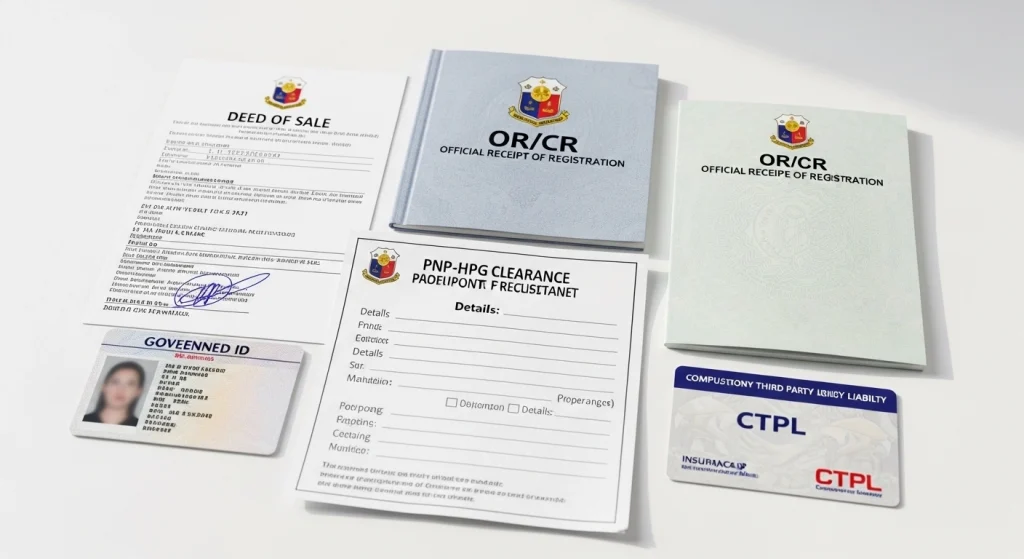
Before you visit the LTO branch, get every document ready. Missing even one will send you back home. These are the LTO requirements for the transfer of ownership for cars in 2026:
Car vs Motorcycle
Requirement | Car | Motorcycle |
Notarized Deed of Sale | Required | Required |
PNP-HPG Clearance | Required | Required |
Emission Test | Required | Required |
Chattel Mortgage Release | If applicable | If applicable |
Secretary’s Certificate | If the seller is a corporation | If the seller is a corporation |
Special Modification Notes | Not usually needed | Needed if modified or with a sidecar |
Tips to Avoid Getting Rejected at the LTO
Most rejections happen for avoidable reasons. Keep these in mind before you go:
- Cross-check the engine number and chassis number on the physical vehicle against every single document
- Make sure the OR is not expired before submission
- Confirm you are going to the correct LTO branch (the one where the vehicle was originally registered)
- Bring photocopies of every document along with the originals
- Do not leave blank fields in the Deed of Sale
- Sign the Deed of Sale in front of the notary, not before
If your OR or CR is lost, do not panic. You can use the ” Track and Request Certified True Copies guide on this site to request replacement documentation from the LTO before processing the transfer.
And if you have previously registered on the LTO portal and lost your login details, the “ How to Retrieve LTO account guide on this site walks you through the recovery steps quickly.

What Happens If You Don't Transfer Ownership
Some buyers assume the deed of sale is enough and postpone the LTO process. That is a costly mistake. Here is what actually happens when the ownership transfer is not completed:
- The original owner remains the registered owner in the LTO database
- Any traffic violations recorded against the plate are billed to the old owner
- The new driver has no legal standing over the vehicle if disputes arise
- Registration renewal becomes complicated because the name on the OR/CR does not match the current owner
- Future resale of the vehicle becomes difficult because the ownership chain is unclear
For the seller, the risk is even higher. You sold the car, but it is still legally yours on paper. If the buyer causes an accident, gets caught for a crime, or racks up violations, those problems can circle back to you.
Penalties for late transfer in 2026 include surcharges on registration fees and a fixed penalty per violation recorded under the unresolved registration. Get the transfer done as soon as the sale is finalized.
Use the LTO tracker on this site to monitor registration status and verify that the transfer has been properly reflected in the system after your visit.
Confirm your vehicle’s registered details using our guide on how to check your LTO plate number.
Who Needs to File for LTO Change of Ownership
This process is not just for private car sales. It applies in all of these situations:
- Private sale between two individuals
- Purchase from a used car dealership
- Vehicle transferred within a family (parent to child, siblings, etc.)
- Donation of a vehicle
- Inheritance of a vehicle
- Corporate vehicle transferred to a private owner
In every single one of these cases, the new owner must file for a change of ownership LTO to be legally recognized. The LTO advises completing the transfer as soon as the transaction is done. Postponing it creates complications for registration renewal, insurance claims, and future resale.
Make sure your credentials are valid by reviewing the requirements for an LTO driver’s license.
Step-by-Step Process for LTO Change of Ownership
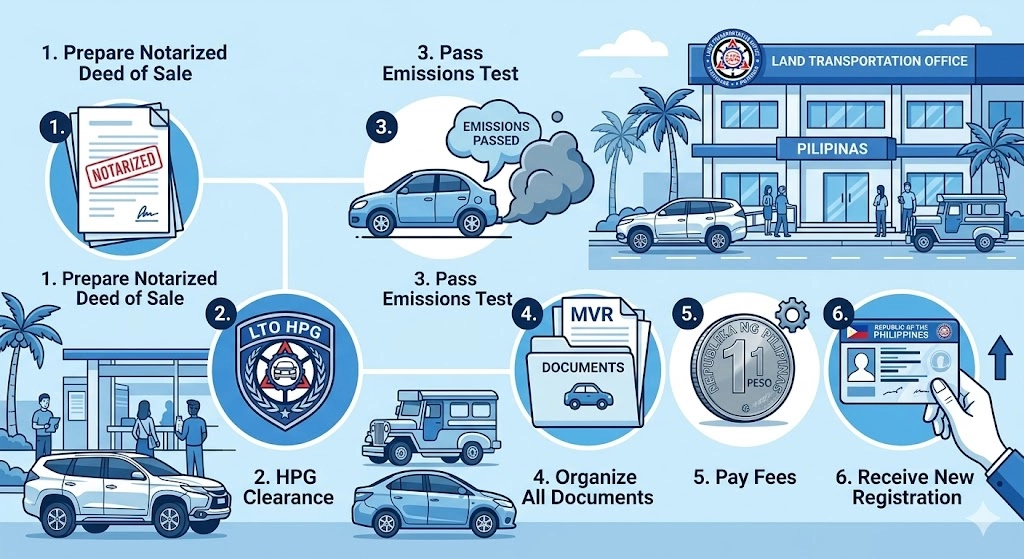
Check for Outstanding Violations and Loan Status First
Before anything else, verify the vehicle has no unpaid fines or active alarms. Use the check LTO violations and alarms guide on this website to run a quick check on the plate number. If there are violations associated with the vehicle, they must be cleared first. An existing loan also needs a chattel mortgage release from the bank before the LTO will process the transfer.
Prepare and Notarize the Deed of Sale
Both the buyer and the seller sign the Deed of Sale before a notary public. Double-check every vehicle detail on the document. A single mismatched number (engine, chassis, or plate) will cause rejection at the LTO counter.
Receive Your Updated OR and CR
After payment and processing, you receive a new Official Receipt and Certificate of Registration with the buyer’s name. This is the official proof that the LTO transfer of ownership is complete. Make photocopies immediately and keep them in a safe place.
Get the PNP-HPG Motor Vehicle Clearance
Visit any PNP-HPG office with the OR, CR, and Deed of Sale. Processing time can range from a few days to over a week, depending on the office and current workload. Do not wait until the last minute on this one.
Pass the Emission Test at an Accredited PETC
Bring the vehicle to an LTO-accredited emission testing center. The certificate they issue is part of your document submission. You can verify which centers are currently accredited by checking the LTO portal login and registration section of this site.
Go to the Correct LTO Branch
This step trips up a lot of people. You must go to the specific LTO branch where the vehicle was originally registered. That branch holds the vehicle’s records and has jurisdiction over the transfer. Going to a different branch will not work.
Submit All Documents and Pay the Fees
Hand over your complete document set at the LTO window. The staff will review the paperwork, cross-check vehicle records, and calculate the applicable fees. Pay at the cashier and keep all your receipts.
How Long Does the Transfer Take
With a complete and correct document set, the entire process typically takes one to two weeks. Here is a realistic breakdown:
- PNP-HPG clearance: three to seven working days
- Emission test: same day if you walk in early
- LTO processing after submission: one to three working days in most branches
- Updated OR and CR release: same day as processing in many branches, or up to a week in busier ones
Delays happen when documents have mismatches, when violations are found, or when the branch is dealing with a heavy backlog. Planning ahead and arriving with complete paperwork is the best way to stay on schedule.
Waiting on your physical plates? Learn about LTO replacement plate tracking.
LTO Transfer of Ownership Fee: Full Cost Breakdown (2026)
The LTO transfer of ownership fee is not a single flat charge. It is a combination of several fees, and the total depends on your vehicle type, the branch, and whether any penalties apply.
Transfer of Ownership LTO Fee Breakdown (2026)
Fee Item | Approximate Amount | Notes |
Transfer fee | ₱400 to ₱600 | Varies by vehicle type and branch |
Registration fee | ₱1,600 to ₱3,000+ | Based on vehicle weight and classification |
Emission testing fee | ₱500 to ₱800 | Paid at the PETC, not at LTO |
PNP-HPG clearance fee | ₱150 to ₱300 | Paid at the PNP-HPG office |
Notarization fee | ₱200 to ₱500 | Paid at a notary public |
CTPL insurance | ₱500 to ₱1,000+ | Varies by coverage period and insurer |
Late transfer penalty (if applicable) | ₱300 to ₱500+ | Applied if transfer is delayed beyond the advisable timeframe |
The transfer of ownership LTO price you actually pay depends on the combination above. Budget at least ₱4,000 to ₱6,000+ to cover the full process from notarization to registration. Financed vehicles with chattel mortgage releases may have additional bank-side charges.
If your records are missing, solve the issue by learning how to fix not found LTO plate status.
Frequently Asked Questions
Can someone else process the LTO transfer of ownership on my behalf?
Yes. The buyer or seller can authorize a representative to process the transfer. That representative must bring a signed authorization letter, their own valid ID, and a copy of the authorizing party’s ID, along with all the required documents.
Can I drive the vehicle while the transfer is still being processed?
Technically, yes, but legal responsibility still belongs to the registered owner in the LTO system. If a violation occurs during this period, it is recorded under the old owner’s name.
What if the seller has already passed away?
This type of transfer falls under estate settlement. The heirs must present a death certificate, an Extrajudicial Settlement of Estate or a court order, and other documents proving rightful ownership before the LTO will process the transfer.
Is the transfer process different for brand-new vehicles from a dealership?
For brand-new cars from an authorized dealer, the dealer typically handles the initial registration. Ownership is established in the buyer’s name from the start, so a standard transfer of ownership is not required.
Can I check the status of my transfer online?
Yes. After submitting your documents, you can monitor the status using the LTO tracker. These let you check whether the updated CR has been processed without needing to visit the branch repeatedly.
What if my plate number shows a replacement or not-found status?
This sometimes happens with vehicles that have pending plate releases or system mismatches. Use the replacement plate tracking tool and the how to fix not found LTO plate status guide available on this site to address this before starting your ownership transfer.
What is the fastest way to complete the LTO change of ownership?
The fastest route is preparation. Arrive at the PNP-HPG office early in the morning to avoid long queues. Schedule your emission test on the same day if possible. Organize every document before going to the LTO branch and make sure nothing is missing.

